Thursday, June 10, 2010

Making Paper in a Pour Vat in the Garden


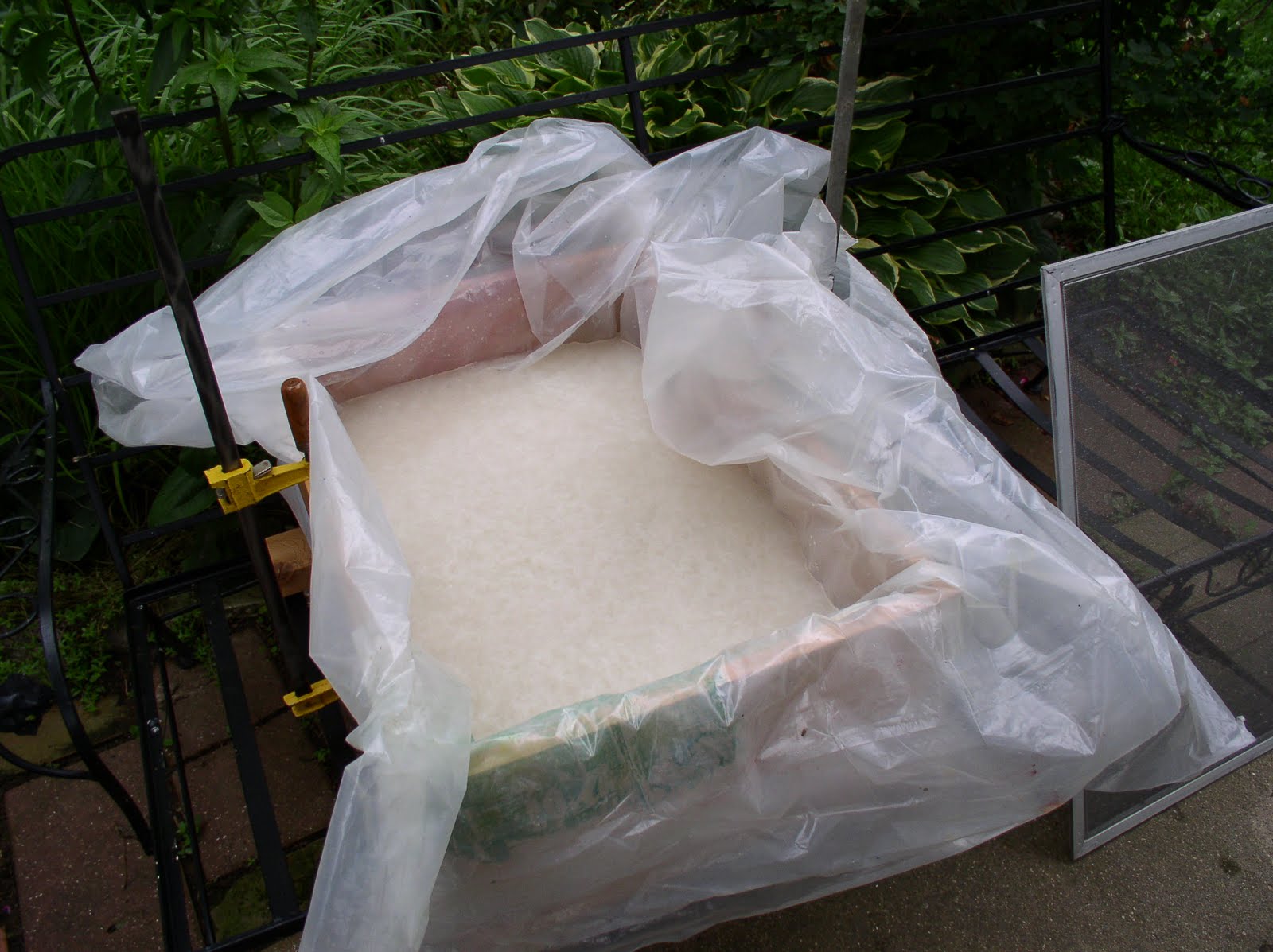
Early this morning, with cup of coffee in hand, I set up a papermaking station in the garden.  I made the pour vat a few years ago out of wood, pipe clamps and Carraige House Heat Shrinking Polypropylene Screening while creating a series of larger handmade paper pieces. 


This pour vat was lined with plastic and filled with overbeated flax fibers beaten in my Critter hollander beater..
 

Once the fibers were evenly dispersed in the water, I held my breath and prepared to pull.


With much concentration, and a bit of brute strength, the plastic was quickly removed.


Quickly, the vat was gently shaken as the water drained and the fibers settled on the pellon felt.


The pulp was allowed to drain for a few minutes before the deckle was removed.


The color variation in the pulp was created by pouring a second batch of older overbeated flax over the pulp before it drained. The older flax had been stored in my fridge since 2005.


The wet pulp and felt were carefully pulled off the mould and onto an old window screen before a piece of burlap Columbian coffee bag was placed over the pulp for texture. The metal grid was placed over the burlap.


The whole stack was flipped over and the window screen was removed.


Finally, wooden boards and concrete pavers were placed over the stack to restrain dry for the rest of the day.


I pulled three pieces of paper this morning, two overbeaten flax and one overbeaten abaca.  Hopefully they will be dry by tomorrow and ready for the next step - geletin sizing, piecing, sewing, indigo, walnut dye, etc.

Wednesday, June 9, 2010

Pulped Pants


I first wore these linen pants to my daughter, Betsy's, undergrad graduation from Florida Gulf Coast University a few years ago.  Now that I am 14 pounds lighter, the pants were either going to Goodwill or the studio. 


After cutting up the linen with a roto cutter and putting it in the critter (hollander beater), 1/2 pound of abaca was added to get things moving.  Test sheets have been made at 2 and 3 hours.  At 3 hours, the pulp still wants to clump up after moving freely for no more than 10 minutes.  The bottom layer of pulp moves, but there is a top layer that wants to stop and just float.  Looking forward to tomorrow's tests. 

Saturday, June 5, 2010

Flax in the Critter


Put a load of Type R flax from Carriage House in my critter (hollander beater) at 1:15pm to beat until 7:15.  A critter, handbuilt by Mark Lander in Loburn, New Zealand, is a hollander beater used for processing fiber into pulp for papermaking. Half of the flax was beaten in a vintage Lee McDonald beater at SIUE on Friday. We will compare notes on the flax on Monday.  It feels so good to have the opportunity to have my hands back in a vat of pulp again.  For me, the process of papermaking has always been a cathartic experience that cleanses and pacifies my soul.

Thursday, May 27, 2010

Recent News Article About My 6th Grade Art Class

Oakville Middle School Art Students Benefit from Designated "Play" Time

The sixth grade art students at Oakville Middle School recently had the opportunity for designated “play” time when they participated in the “Hands, Heart and Mind” Environmental Education workshop provided by Susan Blandford, executive director of the St. Louis Teachers’ Recycle Center, Inc., on Thursday, May 6. The workshop, which provided students with creative, hands-on curriculum, was funded through a grant from the local chapter of the Painters and Allied Trades for Children’s Hope (PATCH) Foundation.

During the workshop, Blandford instructed students to select a type of recycled material and play with it for 15 minutes. Following their play session, students then wrote about what they did with their materials and why; Blandford also gave students the opportunity to explain their artwork to their classmates.

“It’s the process, not the product, that matters,” said Blandford. “It’s about the way you think. There is no right answer.”

The St. Louis Teachers’ Recycle Center, Inc. gathers creative materials from local businesses and industries that otherwise would have been thrown away and makes them available to teachers, parents and youth groups. The organization’s traveling reuse center, “Van GO,” allows Blandford to collect and distribute materials used to motivate creative learning and thinking among students.

The OMS sixth graders who participated in Blandford’s workshop are students in art teacher Elizabeth Adams-Marks’ exploratory class. During this section of the course, Adams-Marks teaches students about careers in the field of art, and the sixth graders are responsible for using recycled materials to design and create a structure relating to an art career.

“This workshop ties directly into the interdisciplinary curriculum of our career wheel,” Adams-Marks said.

The “Hands, Heart and Mind” Environmental Education workshop was funded for the OMS students by the local chapter of the PATCH Foundation, which was founded by members of the International Union of Painters and Allied Trades to support children’s charities.

“This seemed like a win-win program; the kids benefit from the workshop and the materials are kept out of the landfill,” said Gary Otten, member of the local PATCH Foundation chapter who suggested giving a grant to the Teachers’ Recycle Center. “I thought it was a good idea, and I’m glad it worked out.”

http://www.mehlvilleschooldistrict.com/wc/Default.asp?info=856968784_1-PressRelease-370&Previous=

http://stlouisteachersrecycle.homestead.com/

Saturday, May 22, 2010

Papermaking with Children

If you are interested in making paper with your children over the summer, follow the link to one of my lessons on papermaking with kids at Incredibleart.org. You will need very few supplies, most of which you probably already own. http://www.princetonol.com/groups/iad/lessons/middle/elizabeth-paper.htm

Saturday, April 17, 2010

The Cows Have Come Home

Looking west from our windows, the pasture is once again home to the neighbor's cows. Each year, it is a joy to have these animals so close to the garden without the responsibility. Peter and Cleo, better known as Baby Cat, watched as the farmer wandered the field between our homes today in anticipation of the new calves to arrive any day.

Cleo (Baby Cat) watching the cows

Monday, April 5, 2010

Easter Monday - Grading in the Garden


Bright and early Easter Monday morning, I decided that the students' papers that had been tucked away in the back of my mind needed to be graded before other distractions, like weeding and pruning, might convince me to dally. At 7:30 am, the sunshine was working hard to burn through a soft haze of fog hanging over the pasture. With laundry on the line, I asked Peter to take a few photos of me grading in the garden to prove that I DID grade papers today - although my thoughts were at the bottom of the garden where the new raised beds soon will be built.


Now that the hypertufa fountain is up and running, Springtime is officially here.  Thanks to the help of my dear friend, Nancy Hansel, the patio garden and the front garden are also cleaned and waiting for the annuals to be planted.

We heard from the farmer across the way that his cows will be returning later this week to the pasture at the edge of our garden to calf.   We can hardly wait.