Showing posts with label hollander beater. Show all posts

Saturday, April 2, 2011

Handmade Paper from Corn Fiber with Middle School Students

My Art 2 8th grade students at Oakville Middle School are currently learning the process of making handmade paper from plants. Although my school is located in the suburbs south of St. Louis, I live almost an hour away, northeast of St. Louis at the edge of the Illinois prairie. Corn leaves and husks, collected from the field across the lane from my home garden, were cut into small pieces by the students, soaked overnight and cooked in sodium carbonate in the classroom.

When the corn pieces were cooked until the fibers pulled apart, the pot was cooled. The fiber was rinsed until the lignen was removed from the fibrous cellulose.


Since we do not have a hollander beater at school, the cooked fiber was processed (macerated into individual fibers) in my Mark Lander "Critter" at my home studio and returned to school the next day. I did add some cotton and abaca to the corn fiber in the beater so the pulp would drain slower when making sheets of paper.

When teaching adults, I add formation aid (added to water in vat of pulp to raise the viscosity and slow drain time when pulling sheet of paper) and sizing (added to water in vat so dry paper may be painted on with a wet medium later) to the vat, but the sizing caused a rash on the hands of one student a few years ago. Now, I include formation aid and sizing only on the vocabulary study guide for my middle schoolers.


Since the students will be using colored pulp in addition to the corn pulp, they soaked and beat up cotton and abaca linters with a wiz mixer in the classroom. Everyone had the opportunity to take a turn.


Pigment and a retention agent was added to color the pulp for papermaking next week.  Besides experiencing the process, the students will also be expected to learn and understand the vocabulary, basic chemistry and history of papermaking.  Students will be assessed for this project through observation, group/individual discussion, a reading/research written response, a written vocabulary quiz, and the final development and creation of their artwork.

Thursday, June 10, 2010

Mourning Has Broken

As I was cleaning and organizing the wet studio on Wednesday for the next three weeks of papermaking, I rediscovered many of the textiles and handmade paper artworks I created and exhibited, then stored while working on my BFA and BS in Art Ed a few years ago.  Although my busy schedule teaching and finishing my MSEd has only allowed me a minimum of time to create new art, I did have snippets of time in the studio creating work for two shows at Main Street Art Gallery in Edwardsville.  Yet, I didn't have it in me to clear off the shelves or dig through the piles of scraps saved just in case they could be used in the future.  What I didn't realize until this week was that each object I had stored still held memory, and with that memory, a power to keep me from moving on.  Most of my artwork during the past decade has focused on people who I have lost, found or abandoned during my life.  One of the pieces created for my BFA show had the same title. 

Lost, Found and Abandoned (2006)

Yet this week was different.  As I unwrapped each piece, I felt the loss of each person's death along with the joy of having loved that person in life.  Package after package, person after person, I allowed myself to grieve and to cry for their absence.  And when it was done, I was free.  The fifteen-year-long process of healing was complete.


For the rest of the day, the muck of the wet studio could not suppress my boundless joy! As I worked, I kept hearing Cat Stevens' song, Morning Has Broken.  What a gift from our Lord!!  Cleaning was pure pleasure. 


Pumped with turtle power (one little step at a time, just like my recovery), the studio was cleaned from the floor drain to the top shelves while the Hollander beater hummed along filled with flax.  In July, Betsy and I will clean the two second floor rooms and turn my little dry studio into her guest room, while moving the studio supplies into her larger old bedroom.  I can hardly wait to open the rest of the boxes and get on with living life!!

Making Paper in a Pour Vat in the Garden


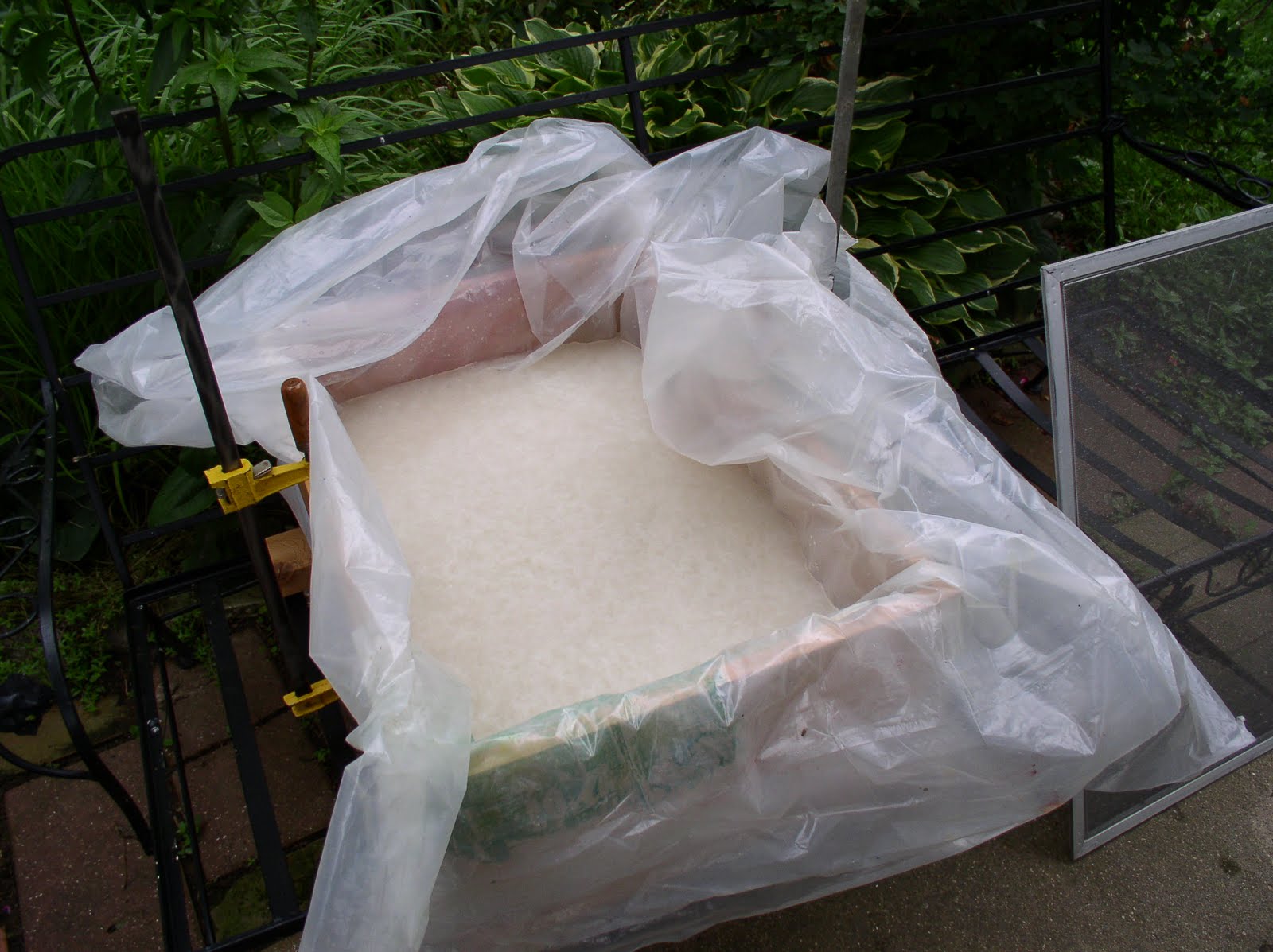
Early this morning, with cup of coffee in hand, I set up a papermaking station in the garden.  I made the pour vat a few years ago out of wood, pipe clamps and Carraige House Heat Shrinking Polypropylene Screening while creating a series of larger handmade paper pieces. 


This pour vat was lined with plastic and filled with overbeated flax fibers beaten in my Critter hollander beater..
 

Once the fibers were evenly dispersed in the water, I held my breath and prepared to pull.


With much concentration, and a bit of brute strength, the plastic was quickly removed.


Quickly, the vat was gently shaken as the water drained and the fibers settled on the pellon felt.


The pulp was allowed to drain for a few minutes before the deckle was removed.


The color variation in the pulp was created by pouring a second batch of older overbeated flax over the pulp before it drained. The older flax had been stored in my fridge since 2005.


The wet pulp and felt were carefully pulled off the mould and onto an old window screen before a piece of burlap Columbian coffee bag was placed over the pulp for texture. The metal grid was placed over the burlap.


The whole stack was flipped over and the window screen was removed.


Finally, wooden boards and concrete pavers were placed over the stack to restrain dry for the rest of the day.


I pulled three pieces of paper this morning, two overbeaten flax and one overbeaten abaca.  Hopefully they will be dry by tomorrow and ready for the next step - geletin sizing, piecing, sewing, indigo, walnut dye, etc.

Wednesday, June 9, 2010

Pulped Pants


I first wore these linen pants to my daughter, Betsy's, undergrad graduation from Florida Gulf Coast University a few years ago.  Now that I am 14 pounds lighter, the pants were either going to Goodwill or the studio. 


After cutting up the linen with a roto cutter and putting it in the critter (hollander beater), 1/2 pound of abaca was added to get things moving.  Test sheets have been made at 2 and 3 hours.  At 3 hours, the pulp still wants to clump up after moving freely for no more than 10 minutes.  The bottom layer of pulp moves, but there is a top layer that wants to stop and just float.  Looking forward to tomorrow's tests. 

Saturday, June 5, 2010

Flax in the Critter


Put a load of Type R flax from Carriage House in my critter (hollander beater) at 1:15pm to beat until 7:15.  A critter, handbuilt by Mark Lander in Loburn, New Zealand, is a hollander beater used for processing fiber into pulp for papermaking. Half of the flax was beaten in a vintage Lee McDonald beater at SIUE on Friday. We will compare notes on the flax on Monday.  It feels so good to have the opportunity to have my hands back in a vat of pulp again.  For me, the process of papermaking has always been a cathartic experience that cleanses and pacifies my soul.