Tuesday, June 26, 2012

Pebbles, Paint and Possibilities

St. Ives
This rough and rugged place of pebbled beaches, azure blue sky, teal green sea, deadly cliffs, narrow lanes, iron age circles, tropical gardens, open moors, and herds of wild ponies overwhelms my creative senses to the point of near panic and procrastination.

Mevagissey
Ever since I first arrived in Cornwall in 1999, I have been in love with the land, the sea, the history and the people. My husband's people come from this ancient place and still reside in villages of Mevagissey and Fowey, very near the place my husband, Peter, was born in Mt. Charles.

Fowey


Charlestown Quay down the road from Mt. Charles

For the first 8-9 years of our travels to Cornwall, I was a mad woman absorbing the culture, environment, language, and history as quickly as possible ... while feeling an obligation to made art.

With limited time slipping away, I frantically filled sketchbooks with black and white illustrations of people, boats, historic locations and everyday life.  Or felt the rush, excitement AND panic in my chest as I attempt to capture the constantly changing light as the weather allowed.

Gorran Haven 2008
Rock Pool Series 2008
But in 2008, the abstracted, cubist landscapes of St. Ives artist, Peter Lanyon (1918-1964), made me rethink the way I approach space and perspective. This epiphany changed my approach to painting, as well as my abstract handmade paper constructions. But I still felt pressed to MAKE art.

But this year, I have not allowed myself to stress out about some pre-conceived fictional deadline.  Before we left the States, I gave myself permission - to slow down even more. 
To give myself ... my art ... my relationship with Peter ... and my spirit ... 
a chance to breath. 


This year, we returned to St. Ives by train.

St. Ives

St. Ives
Wandering in and out of galleries down to the Tate, it was Lar Cann's (1943 --) current abstract paintings of the rock quarries of Cornwall that gave us both pause. Simple, beautiful, intense, and textured in glorious colors!

What took me so long to embrace similar intense hues in my paintings? Fear of boldness? 
Thus, I am once again drawn to simplification, minimalization, and abstraction ... with the addition of a more passionate color palette ... allowing intuition to be inspired by the microcosmic landscapes embedded within and upon the beach pebbles themselves.  If you think my choice of colors seem too brash, you have never walked along the surf of a Cornish beach in the sunshine. 

Cornwall 2012 - Painting 1
Add a bit of cubist landscape ...  

Cornwall 2012 - Painting 2
Cornwall 2012 - Painting 3
And perhaps a sea creature or two ...

Cornwall 2012 - Painting 4
Work in progress
I spy from my temporary studio window, 
set high above the Mevagissey quay and the English Channel beyond ... 


pebbles, paint and an array of possibilities for our final week abroad.


Tuesday, June 19, 2012

In Search of Sherlock Holmes and the Diabolical Hound of Dartmoor


This time last year, my husband and I set off to Port Isaac, Cornwall, UK on a quest for Doc Martin for a dear friend, Pat Vivod, an amazing textile artist in Illinois who loves the ITV show which airs on PBS in St. Louis, Missouri, USA. You can read more about her eco-dying with rust, tea and other natural ingredients on her blog, Sentimental Pentimento. Peter and I carried a silk scarf eco-dyed by Pat to Port Isaac with plans to photograph the scarf on location - only to come face-to-face with the entire cast taping the new season.  Read my 29 June, 2011 blog post for more information about that quest.


This year, knowing that Pat, as well as friends: Denny, Kim, Cindi, Elizabeth, Anne, (shall I go on?) and myself, are also huge fans of the new BBC hit, Sherlock, a new quest was planned!! With ordinance survey map, Pat's silk scarf, and a bag of Cornish pasties with saffron buns in hand, my dear friend, Jackie Bone (Kim's mum, who is also my husband's niece), and I set out across Dartmoor by car and foot in search of the location of Season 1, Episode 2, of the modern BBC version of Sherlock Holmes


Set on Dartmoor, The Hounds of [the]Baskerville(s), has thrilled and terrified audiences since it was originally written as a crime novel by Sir Arthur Conan and serialized in The Strand Magazine from August 1901 to April 1902.  One can read more about the modern Sherlock version of the Hounds of Baskerville on the blog of Dr. John H. Watson


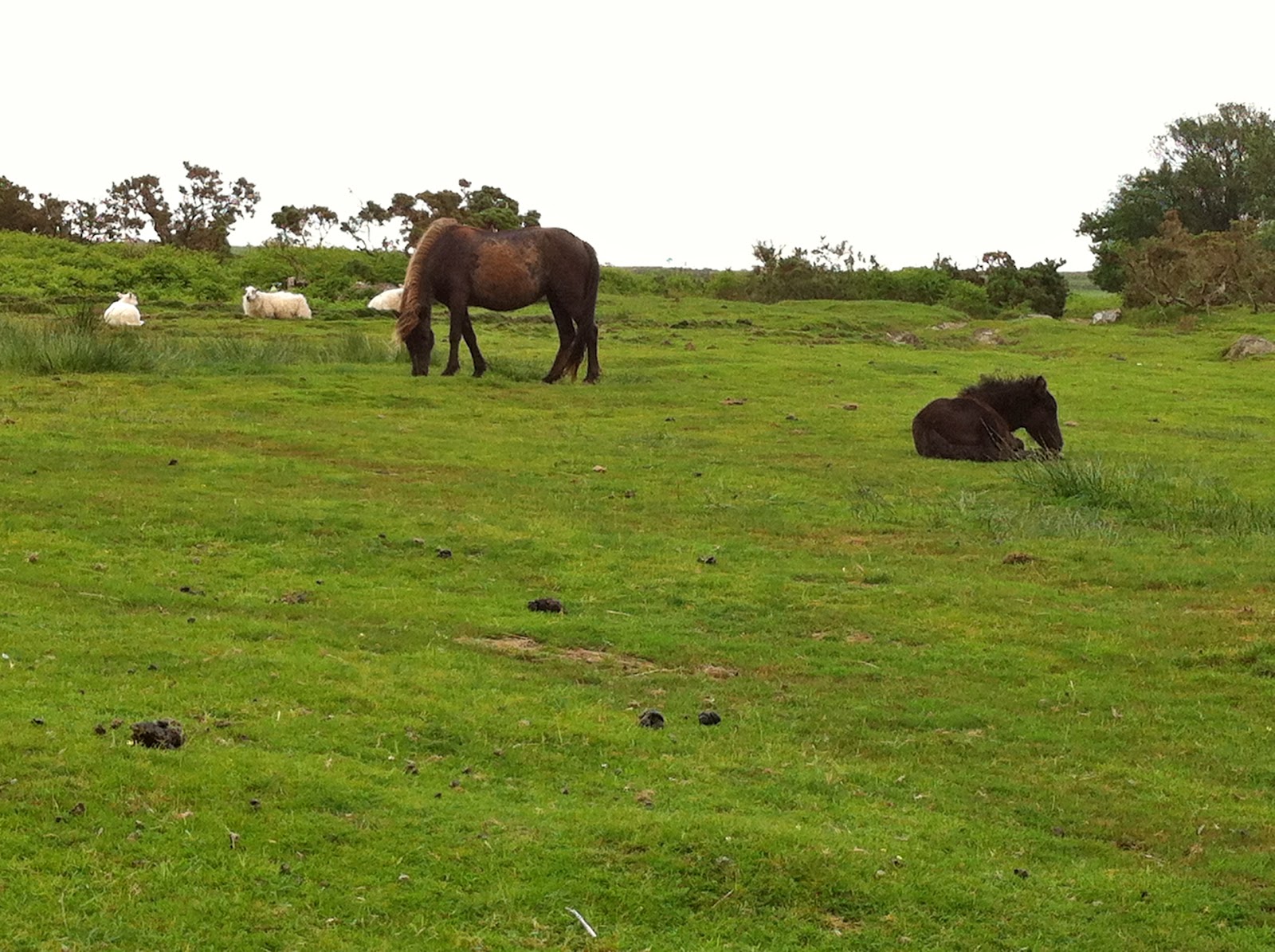
While we may have hoped to catch a glimpse of the infamously diabolical hound running across the moors, what actually roams the heather and heath are free range sheep, ponies and cattle. One such pony became very interested in our adventure and hoped to get a closer look at our plan.


Not to be deterred, we continued our search!

Through river valleys ....


and golden broom in bloom...


Past pre-historic settlements ...


to ancient stone circles and iron age circle huts.


Beyond sleeping giants resting atop granite tors ...


and solitary monuments dedicated to young soldiers long ago lost in some forgotten war.


The land spoke not a word. Nor the animals that roamed. All was still, but for the call of distant birds ...


and the baaaa of listless sheep.


 So on we travelled ... down into valleys between narrow lanes lined with high stone walls covered with centuries of wild flowers and ancient trees dressed in multi-shades of viridian moss ...


Past the Dartmoor ponies...


and dutiful cows nursing their calves ...


Until we came to our journey's end ...  


without a hound in sight.


Wednesday, June 13, 2012

Pinky Murphy's Cafe - Surf's Up in Cornwall


Wandering along the narrow streets of Fowey, Cornwall, we chose the eclectic world of Pinky Murphy's Cafe for lunch. A cross between Southern California in '68 and the surfer beach huts in Cornwall today, Pinky Murphy's is a kaleidoscope of delicious colors, patterns, textures and aromas with couches, bean bag chairs, and comfortable beach chairs covered with fluffy pillows and beach towels arranged for cozy seating.


Open 7 days a week, 9-ish to 5-ish (Sunday 9:30 to 4-ish), the cafe has a wide selection of food beautifully prepared, including daily specials worthy of a return trip. While they don't serve pints or wine, one may BYOB anytime and they will provide the glasses. Peter enjoyed a cutting board platter of parma ham, salami and homemade pate served with homemade bread, green salad leaves, blushing tomatoes and sweet chili sauce. I selected one of the specials - baked sweet potato with goats cheese and a green salad with balsamic dressing. 


Although the outside seating is limited, if one is lucky enough to rest awhile on the front deck overlooking the Fowey River and the narrow lane below, one might curl up with a cup of tea and a good book, or gather with a group of friends after the "gentle" 4 mile stroll around Hall Walk.

HALL WALK - (As easy as walking up and down any well worn path at a 30 degree angle)
Basic walk: from Fowey across the Bodinnick Ferry, climbing to Hall Walk which us south to Pont Pill, then over the hill past Lanteglos Church to Lantic Bay and west to lower ferry at Polruan. Back through the streets of Fowey.
Recommended map: OS Explorer 107 St Austell and Liskeard.
Distance and going: four miles, easy going.

Maps and Hall Walk info above from: http://www.westcountrywalks.com/mid-se-cornwall/cornwall-secorner/fowey-polruan/fowey-polruan.php


Saturday, April 14, 2012

Indigo Dying with Middle School Teens


World history, American history, geography, chemistry, social studies, music and visual art combined! For the past three years, the indigo vat has been set up in the Oakville Middle School art studio classroom for the 8th grade Art 2 students' study of the history of indigo and slavery.

Student allowing indigo to drip in pan after in dying in vat (bottom of photo)

Dying fiber in indigo is magical! Students were once again amazed as their projects emerged a deep lime green from the vat, but transformed into deep shades of blue before their eyes as the oxygen from the air they breathed attached to the oxygen starved dye.

Bundles oxidizing on the drip rack

Before dying, students had to create a design for their projects by applying a variety of Elements and Principles of Design, such as : movement, line, pattern, rhythm, shape, value, contrast, and emphasis.  

By implementing clamp, tie and stitch resist techniques, the fifty-seven students dyed their T-shirts or pillowcases over three to four class periods. 

While they waited for their turn to dye, they listened to various musical artists from Africa
 and researched the history of indigo and the slave trade. 
For more information about this research project


After dying their projects multiple times to achieve the value and intensity of blue they desired (with the understanding that dry fiber is considerably lighter in value than wet), 
they began to untie and wash their bundles.


After removing all clamps, tying and stitching, the students helped each other wash any residual dye from the fiber. 


The students were thrilled with the results!


After the projects were washed by the students, I gave them a good wash in my machine at home and brought them back the next day for the students to complete their written assessments.


While the indigo vat was "up and running," many of the thirty-seven OMS Art Club students, who do not have a regular art classes because of band or special education classes, also took advantage of the opportunity to dye their own shirts and socks during their regularly scheduled two hour meeting 
every other Wednesday after school.  
Admittedly, in a middle school culture of sports logos and Hello Kitty, it gives me great pleasure to see glimpses of indigo scurrying down the halls between classes.