Showing posts with label china clay. Show all posts

Friday, August 3, 2012

[context] TEXTURE at Art St. Louis


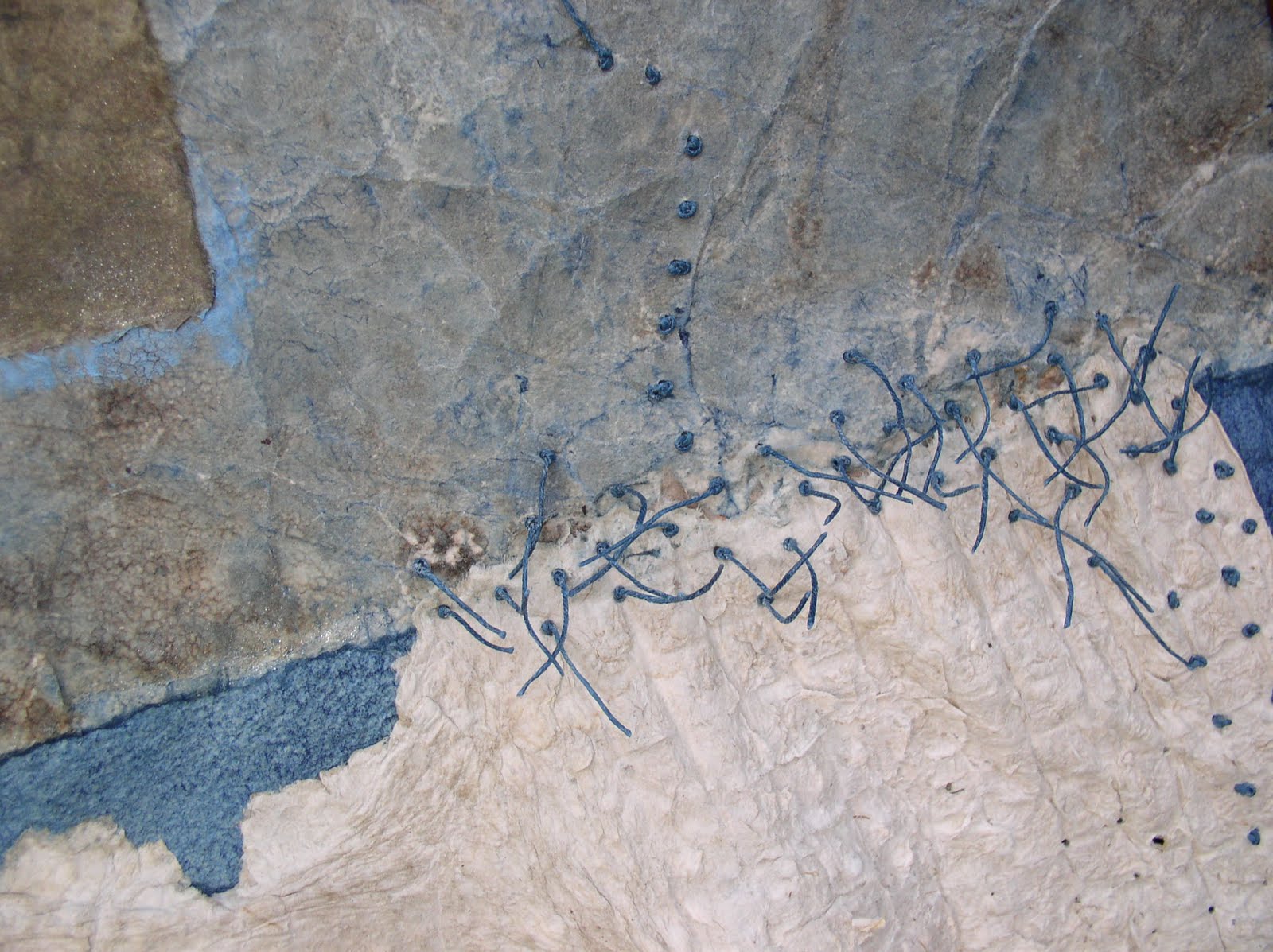
I am pleased to announce that my handmade paper construction, Sun Pans and Mica Drags, has been juried into the exhibition [context] TEXTURE at Art. St. Louis, August 13 - October 4, 2012. Jurors, Joe Chelsa and Jo Stealy, selected 58 works in all media by 44 regional artists from the 208 artworks submitted by 109 artists.


Cornwall, UK, the land of my husband’s birth, has a mining history dating back more than 3000 years.  Women, known as Bal Maidens, worked primarily above ground; but during the World Wars, they were often assigned mining duties previously reserved for men. My intent in Sun Pans and Mica Drags was to capture the essence and remnants of the 19th century china clay mines as seen still today from the air, through the earth and across the moors.

Opening reception is Saturday, August 11, 6-8pm.

Thursday, August 4, 2011

Sun Pans and Mica Drags - 19th Century China Clay Industry in Cornwall


Influenced again by the China Clay industry of Cornwall, UK, my newest abstracted handmade paper landscapes, which will be in the St. Louis biennial Innovations in Textiles exhibition at the Edwardsville Art Center later this month, incorporates 19th century sky tips, sun pans, pan kilns and mica drags as seen from the air, through the earth and across the moors. Our recent trip to Cornwall and a photograph of the China Clay workings near Hensbarrow Downs (below) was inspiration for my latest artwork.  

China Clay workings around Hensbarrow Downs, showing large sky tips, pan kilns and mica drags. 
The photo above was taken from an excellent interactive website, Flying Through Cornwall's Past. 

In Cornwall, water has always been used to wash the kaolin from the soft granite. In the early days of the 19th century, removing the clay was very labor intensive and clay was washed into shallow pits. As technology developed, the waste quartz and mica were removed and the clay was dried in sun pans until the first pan kilns were built in 1845. Waste materials from the pits were transported by tram to spoil tips on the surface which gleamed in the sunlight like pyramids.  Especially interesting to me is the history of the women clay workers. According to the brochure of the China Clay Museum near St. Austell:

Women were employed in the China Clay industry to carry out a particular task before pan kilns dried all the clay at each clay works. At first the clay was left to dry in a shallow tank called a "sun pan". The sun pan was lined with sand and as the clay hardened it was cut blocks were stacked in the air dry, a small open-sided structure where the clay was dried by the circulation of air through the building. The women were then employed at a daily rate to scrape clean the bottom and sides of each block. Two or three tons of day could be cleared in a day, and the women were paid about a shilling a day. 


For more information about mining in Cornwall in the 19th century, check out this link which is a copy of the printed brochure from the China Clay Museum in Cornwall. 


Saturday, March 5, 2011

Join us at the opening of "In, On and Of Paper V" at Foundry Art Centre in St. Charles, MO this Friday March 11 from 6-8pm!

Stone Circles and Estuaries (16x50")

Please join us for the opening of "In, On and Of Paper V" at the Foundry Art Centre, St. Charles, MO, on Friday, March 11 from 6-8pm.  Two of my handmade paper landscapes (shown here) were accepted into the exhibition, juried by papermaker Joan Hall. Both pieces constructed of handmade papers made from various fibers, walnut dye, indigo dye and mixed media were inspired by my photos and paintings of the china clay pits, disused tin mines, iron age ruins and seascapes of my husband's homeland, Cornwall, UK.  The exhibition will run March 11-April 29, 2011.


Tin Mines and China Clay (16x35")


Sunday, February 6, 2011

New Year - New Studio


After remodeling the kitchen last summer; sorting, purging, packing, and painting the entire kitchen and 2nd floor; reorganizing two attic storage spaces; installing 2 skylights on the second floor; refinishing the stairs; setting up a guest bedroom; and reorganizing the contents of three studios into one ... the new dry studio is FINALLY a reality.


And what a difference it makes working in a dry, warm environment in the winter. And what a winter we have had here in Edwardsville!! I am beginning to think we have returned to living in Upstate New York again. The wet papermaking studio is still in the basement and will be remodeled and reorganized when (or if) the snowy weather ever breaks. At least the first and second floors are now bright and welcoming.

Kitchen Remodel 2010


With almost everything in the studio in place, the Cornwall "Tin Mines and China Clay" series of handmade paper constructions continues. The only good thing about a frozen world outside the studio window, is that the garden does not yet beckon me to come out and play.  The same can not be said for my little dog, Dommino.


Friday, July 23, 2010

Tin Mines and China Clay

Mining in Cornwall dates back more than 3000 years when traders from the Mediterranean, such as the ancient Romans, visited Cornwall for their tin mines and other minerals. China clay, or kaolin, was discovered in Cornwall in 1746 by William Cooksworthy who filed his patent in 1768 and established the Plymouth Porcelain Company. Originally course earthenware, the new English white porcelain was available to the wealthy who desired the look of Chinese porcelain.

Although very little tin is mined in Cornwall today, the disused mines stand as beacons to Cornwall's rich history of mining. While China clay is still mined in Cornwall, many of the clay tips that appeared as white pyramids on the horizon during WWII have since been used for building materials.  One of the largest clay pits has been transformed into Eden Project, the largest botanical biosphere gardens in the world.

Eden Project

In May 2005, Peter and I met with Dr. Jo Readman, the Director of Education at Eden Project, when I donated a copy of my research, "Handmade Paper from the Crops of Madison County," to their library. At that time, Eden Project was planning a new exhibition, "Paper Trail," focusing on plants around the globe that might be used in papermaking.

Dr. Jo Readman and Elizabeth at Eden Project's Research Library

Tin Mines and China Clay


Tin Mines and China Clay (detail during construction)

Inspired by the Cornish landscape and knowledge gained through my plein air abstract paintings of Cornwall coastlines, my latest handmade paper constructions were created with flax and abaca paper pigmented, dyed, stitched and textured in the elements of coastal paths, pebbled beaches, disused tin mines that travel deep into the earth and out under the Atlantic, china clay mines that erupt from the landscape, brightly colored fishing boats, windswept moors and the ever-changing atmosphere of the sea.

From Sea to Moors to Sea (new title)

Four of my handmade paper constructions will be on display, along with the five tidal pool paintings, at tonights opening of E.L.E.M.E.N.T.S. at Main Street Art Gallery in Edwardsville, IL from 6-8pm. The exhibition runs July 23 through August 28, 2010.