Showing posts with label handmade paper. Show all posts

Tuesday, August 6, 2013

Cornwall [re]Constructed - Solo Exhibition


I am very excited to announce the solo exhibition of my handmade paper abstract landscapes, "Cornwall [re]Constructed," opening August 23, 2013 at the 
St. Louis Artists' Guild in Clayton, Missouri. 

This newest series of landscapes [re]constructs divergent tangents of historical meaning and myth, abstracting place over time and space, by building up layers of handmade paper subjected to natural elements that rust, tint, dye, emboss, and inform the marks left behind. 


Located on the farthest western tip of the United Kingdom, Cornwall holds two coastlines (the English Channel and the Atlantic Ocean) and is divided from England by the River Tamar.  Cornwall is a land of one-lane hedgerows blanketed in wildflowers; mythical piskies; wild ponies and herds of sheep wandering the moors; tidal pools and estuaries; Neolithic stone circles; and Iron Age villages.  From the time of the early Bronze Age, Cornishmen have mined for copper, silver and tin down into the earth … and out under the sea.


Since kaolin, used for porcelain and later paper, was first discovered in Cornwall in the mid-16th century, the china clay industry pitted the moors and altered the horizon with their white mica waste tips standing proud like gleaming pyramids on the uplands.
 

While Cornish tin mines are now slowly rusting into the granite landscape and china clay tips have all but disappeared, replaced by modern mica plateaus, the people of Cornwall are as strong and resilient as their ancestors. Working fishing villages hold dear to their culture while embracing 21st century tourism. Celtic crosses and ancient stones still stand watch along rocky cliff paths and yellow gorse lined moorland trails. Yet deep in the woodlands, where moss covered stones lead to pre-Christian wells, and hillsides of blue bells are walled by mountainous rhododendrons, one only need to quiet one's heart and listen - for the flutter of wings, the gurgle of springs, and the Spirit of God all around.

The exhibition runs through October 20, 2013. For more information, visit the St. Louis Artists' Guild website. 


Saturday, June 29, 2013

From the Inside Out - Felt, Paper & Textiles: Revelations of Natural Mark Making - An International Exhibition!

Elizabeth Adams-Marks, 2012
My dear friend, Pat Vivod, and I, both from Illinois, USA, were approached by the Jacoby Arts Center 
to put together a fibers show of our recent work in rust printing, eco printing and natural dyeing. After many long, but lovely planning sessions at our favorite coffee houses, diners and kitchen tables, we decided to invite a few other fiber artists who also use natural materials to join us.  
And they all said YES!

Thus, we are pleased to announce we have partnered to curate and participate in 
a 2014 international fibers exhibition

From the Inside Out 
Felt, Paper, Textiles: Revelations of Natural Mark Making

at the
Alton, IL, USA
August 22 - October 3, 2014

Our honored guest artists (in alphabetical order) are:

Irit Dulman - Israel

Fabienne Rey - Netherlands

Rio Wrenn - Oregon, USA 

Although Pat and I have been friends and exhibited together for many years ... 
Fabienne and Irit got together for few days in the Netherlands in 2013 ... 
and Pat has spoken to Rio many times by phone ... 
and we all communicate regularly through social media and emails ...
as a group, we have never met face-to-face. 
Yet, maybe ... someday in the future ...
we might gather in the St. Louis area, or perhaps, 
somewhere overseas!  

Elizabeth Adams-Marks, 2012
For more information about the exhibition and each individual artist, plus regular updates over the next year as the project develops, here is the link to our blog:


Please join us for the opening on August 22, 2014!!

Tuesday, August 7, 2012

[context] TEXTURE - Interview of an Artist


Recently, Jacqueline Klene, with Art St. Louis, interviewed me about my art juried into the [context] TEXTURE show opening Saturday, August 11, 6-8pm at Art St. Louis, as well as my thoughts on being an artist. You can read the edited responses and see the artwork of the four artists interviewed on the August 7th post of the Art St. Louis Blog.


Below is my full response to Jacqueline's questions:

1. How do you feel that your work relates to the theme and exhibit of "[context] Texture"?

My work, Sun Pans and Mica Drags, was constructed with embossed, dyed, pigmented, painted and stitched handmade papers that I made from various plant fibers. Cornwall, UK, the land of my husband’s birth, has a mining history dating back more than 3000 years.  Women, known as Bal Maidens, worked primarily above ground; but during the World Wars, they were often assigned mining duties previously reserved for men. My intent in Sun Pans and Mica Drags was to capture the essence and remnants of the 19th century china clay mines as seen still today from the air, through the earth and across the moors. 


2. What subjects and/or artistic movements influence you the most?

Having been an illustrator, art educator, and an avid gardener for many years, I have always been drawn to aerial views of land, maps, rivers, soil, and organic systems. Experimenting with handmade plant fiber paper is a culmination of that attraction to texture and natural materials. By combining my papers with ephemera collected along the way, my work layers history, meaning, and place into objects that are no longer lost or misplaced, but reconstructed and transformed.


3. Do you find that your work is easy to relate to?

While the history, meaning and place represented by this body of work is significant to me, the viewer who is drawn to the work will bring their own aesthetic preferences and layers of meaning to the work.  Their perceptions, connected to their own memories, are equally valid.

 4. What do you strive for as an artist?

For more than 25 years, I was an illustrator. Every piece of artwork was a literal representation of a person, place or event that had to be easily “read” by the art director, the editor and the intended audience. The medium, colors, subjects, and styles of illustration were selected by the client, not me. Thus, I eventually burnt out. Now, I no longer take commissions. My work is driven by natural materials connected to place, making and meaning with focus on craftsmanship.


5. What is your process?

During the summers, when I am not teaching, my husband and I travel back to Cornwall. His family nurtures us as we wander through working fishing villages and along cliff top paths; down narrow hedgerows onto pebbled beaches and tidal pools; through disused mines and pre-Christian churches; and finally across the moors filled with wild ponies and herds of sheep. Every step is filled with layers of ancient history, place, people, texture, industry, work, survival, beauty and faith.  My process is to read, record, draw, paint, listen, smell, taste, collect memories, and stash bits of ephemera to the point of exhaustion. Back in my garden/studio in Illinois, I distill, clarify and make the handmade paper used in my constructions. The textures and colors are a collection of memories, the essence of Cornwall’s natural beauty and industrial history, non-specific to an exact mine or village. As the constructions are developed, the materials inform and challenge the process of simultaneously layering and abstracting multiple vantage points within the landscapes.


6. When did you decide to become an artist?

As a child, I lived with my father’s parents. They taught the next generations how to make what was used and what was needed. Craftsmanship was important whether we were making a dress on a treadle sewing machine, planting the vegetable garden, or building a cabinet. They didn’t realize they were artists.  They just “made do.” In 1974, I decided to go to St. Louis Community College at Florissant Valley to become a commercial artist after my second knee surgery for rheumatoid arthritis in high school squelched my plans to become a physical therapist. My grandma didn’t think commercial art was “real art,” but I could make a living. When I was offered a job by an advertising agency before I finished my degree, grandma thought I should have stayed in school to finish the Associate Degree. Twenty years later, after working as a successful illustrator for publishers all across the country, she still thought I should finish my degree; and that I still wasn’t a real artist.  Funny how things stick in the back of your mind. When I returned to school in 2002 to earn a teaching degree, I thought of her. And now that I have a BA in K-12 Art Education, a BFA in Art & Design, a MSEd in Secondary Education/Art, and a MA in K-12 Education with an Emphasis in Character Education, with artwork in public and private collections in the United States and England, I still hear her voice in my head and wonder if I have done enough, or would ever do enough, to be a “real artist.”

I am an artist, a teacher, a wife, a mother, a friend, and a woman of faith.  Looking back on the past 56 years of life through the knowledge and understanding of an art educator, I realize that I have always been an artist.  I have always been creative. I have always thought of multiple ways of solving problems. I have always asked, why? It just took 36 years in the field, four degrees, and the faith in oneself that comes with hard work … and age … for me to come to accept, and be proud, of who I am – A R T I S T.


Friday, August 3, 2012

[context] TEXTURE at Art St. Louis


I am pleased to announce that my handmade paper construction, Sun Pans and Mica Drags, has been juried into the exhibition [context] TEXTURE at Art. St. Louis, August 13 - October 4, 2012. Jurors, Joe Chelsa and Jo Stealy, selected 58 works in all media by 44 regional artists from the 208 artworks submitted by 109 artists.


Cornwall, UK, the land of my husband’s birth, has a mining history dating back more than 3000 years.  Women, known as Bal Maidens, worked primarily above ground; but during the World Wars, they were often assigned mining duties previously reserved for men. My intent in Sun Pans and Mica Drags was to capture the essence and remnants of the 19th century china clay mines as seen still today from the air, through the earth and across the moors.

Opening reception is Saturday, August 11, 6-8pm.

Saturday, October 8, 2011

Making Daylilies into Paper


I had the pleasure of presenting my research in papermaking from garden plants and the crops of Madison County to the Southwestern Illinois Hemerocallis Society last evening. Since I knew there were teachers in the Society, my presentation focused on both the process and the interdisciplinary connections made in the classroom.


While the powerpoint images depicting the stages of papermaking from harvesting in the garden to the classroom and studio clearly defined the process, the members and their guests made tangible connections when they finally held my handmade books and closely inspected the construction of my handmade paper landscapes of Cornwall.


Sun Pans and Mica Drags

After carefully examining my landscapes, one member of the Society was excited to share that his grandparents came from Cornwall; and he had been to Liskeard, Cornwall for a family reunion!

The following is a short description from last night's program:


This presentation explores papermaking from plants as a means of experiencing real world interdisciplinary connections between the art studio or classroom and the local organic environment (farms or gardens). By growing and/or harvesting the waste materials (stems, stalks, vines, or leaves) of local crops or landscape plants, processing the pulp, and transforming the pulp into paper for painting, drawings, printing, sculpture, or bookbinding, art students will work together to explore chemistry, botany, agriculture, math, and the history of papermaking, while expanding their critical thinking, planned risk taking, self-motivation, creativity, responsibility, teamwork, time management, interpersonal communication, and a sense of self-worth gained for meeting or exceeding expectations. The presentation will offer step-by-step detailed descriptions and images of the process of papermaking from plants, as well as actual samples of handmade paper and books for teachers who desire art as experience from seed to final binding stitch.


Sunday, August 14, 2011

Innovations in Textiles Opens at EAC This Friday Night in Edwardsville!!


Please join me this Friday, August 19, when the first of the St. Louis "Innovations in Textiles" events opens with a public reception from 7-9pm at the Edwardsville Art Center where my newly created, handmade paper landscape constructions, inspired by our recent trip to Cornwall, UK, will be on display.


The exhibit, curated by Laura Strand, Professor of Textiles at Southern Illinois University, includes a wide variety of artworks created by MFA, BFA and BA alumni who studied with Laura at SIUE: 
Luanne Rimel, Rachel Hayes, Courtney Henson, Christine A. Holtz, Chu Hui Chiu, Lisa Forsyth, Becky Grass, Alicia Pigg, Elizabeth Adams-Marks, Jennifer Toje, Deborah Pontious, Angela Perkinson, Nicole Ottwell, Lillian Bates, Bridget Kraft, and Melissa Cunningham


"Innovations in Textiles" is a biennial event hosted this year by 19 galleries and art organizations in the Bi-State St. Louis area from August through October.  Check the Innovations website for a complete list of the artists, exhibits, artist talks, workshops, maps and bus tours.

Thursday, August 4, 2011

Sun Pans and Mica Drags - 19th Century China Clay Industry in Cornwall


Influenced again by the China Clay industry of Cornwall, UK, my newest abstracted handmade paper landscapes, which will be in the St. Louis biennial Innovations in Textiles exhibition at the Edwardsville Art Center later this month, incorporates 19th century sky tips, sun pans, pan kilns and mica drags as seen from the air, through the earth and across the moors. Our recent trip to Cornwall and a photograph of the China Clay workings near Hensbarrow Downs (below) was inspiration for my latest artwork.  

China Clay workings around Hensbarrow Downs, showing large sky tips, pan kilns and mica drags. 
The photo above was taken from an excellent interactive website, Flying Through Cornwall's Past. 

In Cornwall, water has always been used to wash the kaolin from the soft granite. In the early days of the 19th century, removing the clay was very labor intensive and clay was washed into shallow pits. As technology developed, the waste quartz and mica were removed and the clay was dried in sun pans until the first pan kilns were built in 1845. Waste materials from the pits were transported by tram to spoil tips on the surface which gleamed in the sunlight like pyramids.  Especially interesting to me is the history of the women clay workers. According to the brochure of the China Clay Museum near St. Austell:

Women were employed in the China Clay industry to carry out a particular task before pan kilns dried all the clay at each clay works. At first the clay was left to dry in a shallow tank called a "sun pan". The sun pan was lined with sand and as the clay hardened it was cut blocks were stacked in the air dry, a small open-sided structure where the clay was dried by the circulation of air through the building. The women were then employed at a daily rate to scrape clean the bottom and sides of each block. Two or three tons of day could be cleared in a day, and the women were paid about a shilling a day. 


For more information about mining in Cornwall in the 19th century, check out this link which is a copy of the printed brochure from the China Clay Museum in Cornwall. 


Tuesday, July 5, 2011

Jacoby Arts Center's 7th Annual Juried Exhibition


I am pleased to announce that two of my handmade paper constructions inspired by Cornwall have been accepted in the 7th Annual Juried Exhibition at the Jacoby Arts Center in Alton, IL. Please join us at the opening reception Friday, July 15 from 5-8pm with the awards presentation at 6:30pm.  The exhibition continues from July 12 - August 21, 2011.


Sunday, April 24, 2011

Adinkra Symbols and Aba House in Ghana Inspire Middle School Students


Adinkra Symbols 

For one segment of our handmade paper project, the Art 2 8th grade students at Oakville Middle School learned about Adinkra symbols and handmade paper as part of a cultural exchange of creative ideas at the Aba House in the suburb of Accra, Ghana through the Collaborative Exchange Website. Here's a video of the Aba House children making paper from sugar cane at http://www.culturalcollaborative.org/videos.htm.
A quote from their website: "Cross Cultural Collaborative, Inc. is a non-profit educational organization that promotes cultural exchange and understanding. Our programs emphasize multigenerational and multicultural collaborations encouraging participants to find rewards in different forms of creativity. We bring artists from different cultures together in a supportive environment where they can get to know each other through the language of art. At the core of our program is the belief that interaction between African and non-African artists enriches the creativity of both groups."

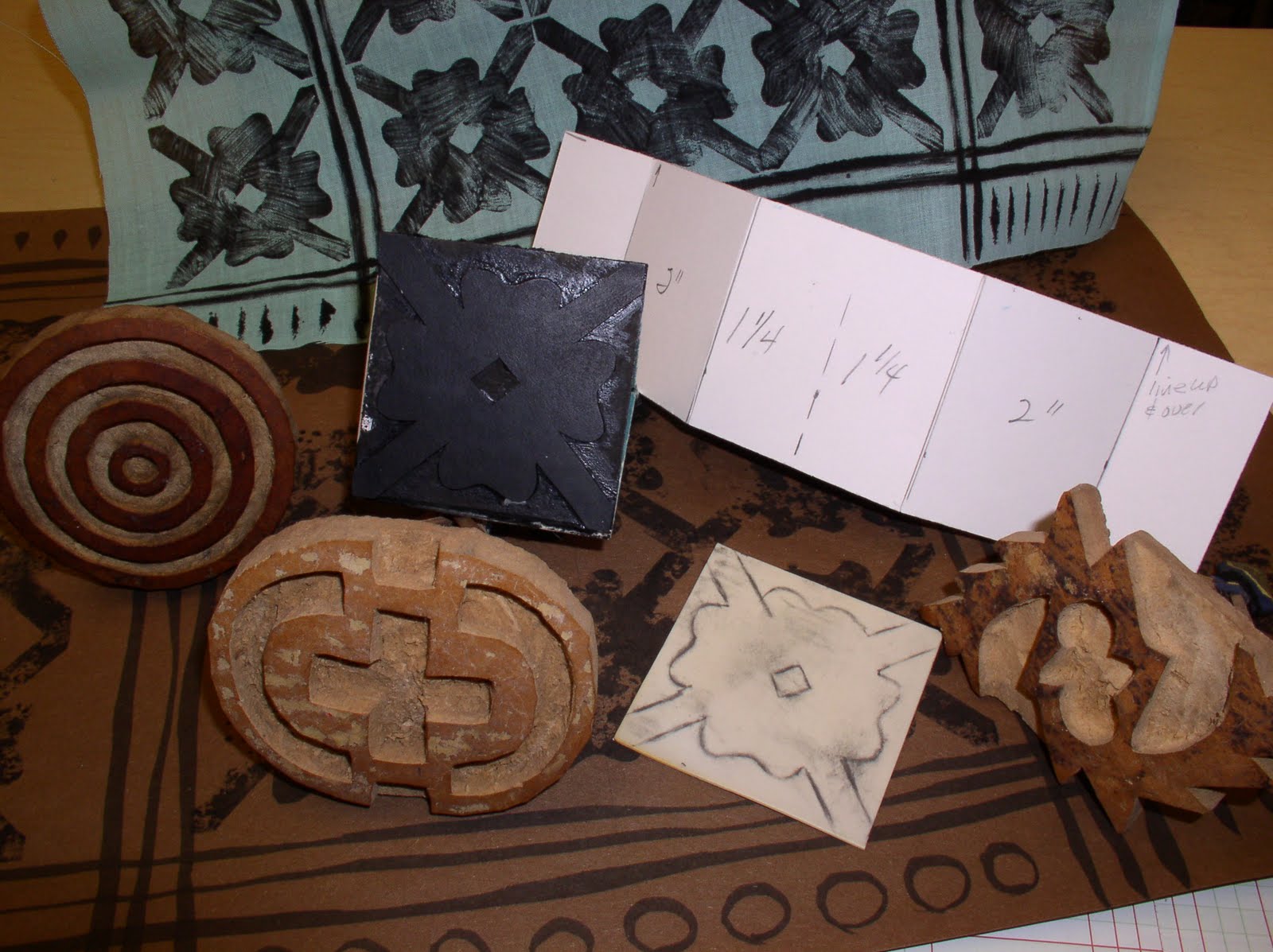
After researching the history of Adinkra and how Adinkra stamps are carved from gourds, the Art 2 students each designed their own personal symbol and created a stamp with adhesive backed easy-cut and mat board.


The students tested printing a variety of colors and patterns with their personal symbols.

When the students were not working on their Adinkra stamps, or making handmade paper, they were each designing a book focusing on their personal interests, beliefs, etc.


Each book was folded and cut from a single sheet of white paper. The students glued their stamped handmade paper to the front and back covers.


Besides the homework research assignment on the history of Adinkra, students were assessed on: their Adinkra symbol design and craftsmanship of printing; the continuity of their idea or theme, craftsmanship and effort for their handmade book; the number of handmade paper pieces (at least 5); and their responsibility in the art studio classroom.


Thursday, April 21, 2011

Handmade Paper with Middle School Students (Part 2)

Pulling sheets of corn and abaca fiber pulp with a mould and deckle

In my classroom, the 8th grade Art 2 students at Oakville Middle School each made five or more pieces of handmade paper from the corn, abaca and cotton fiber they helped process.  When they weren't making paper at one of the four workstations, they were designing the pages for their own handmade book.

 Multiple workstations set up with pigmented abaca and cotton pulp

 Moving a freshly couched sheet of pigmented abaca and cotton paper onto second tray to be sponged

Sponging excess water through a layer of pelon "felt"

Rolling the damp paper flat with rolling pin (bottom) and couching a sheet of paper (top right)

Removing the top pellon "felt" (bottom) before moving paper to the window to dry

HMP drying on classroom window overnight with students' nametags on each sheet

Students experimenting with colored pulp

More experimenting with colored pulp