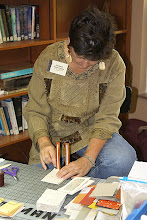
Few things are as exciting to middle school students as watching their lime green cotton cloth magically transform into deep indigo blue! At the beginning of this project, my Art 2 students at Oakville Middle School watched three videos about dyeing in an indigo vat.
One video shows traditional indigo dyeing in Africa - http://www.youtube.com/watch?v=pG1zd3b7q34
One video shows dyeing at Cornell University - http://www.youtube.com/watch?v=7z6B7ismg3k
And the third shows clamp resist dyeing with children -

Students were given the options of stitch resist, clamp resist, bondini knot resist with string and/or plastic wrap, and rubber band resist.

Once the resist designs were in place, the cotton cloth was soaked in water for 10 minutes.


A synthetic indigo vat whad been set up in one corner of the classroom.


Wearing gloves to protect their hands from the dye, the students slowly lowered their cloth into the dye vat and counted to 120 before carefully raising the cloth to the surface.

The cloth was carefully squeezed below the surface, careful not to cause bubbles or drips that would add oxygen into the vat. In one quick motion, the cloth was moved over over a stainless steel pot to collect the drips. The collected liquid would later be reheated and reused.

As the oxygen from the air attached and bonded to the indigo, the cloth turned from green to blue.

The more times the cloth is dyed, the darker the blue. Since the oxidation process takes about 15 minutes, the students rotated between dyeing their cloth and researching the history of indigo and slavery. One of the articles they read was
"Slavery in America and the Devil's Blue Dye," http://www.slaveryinamerica.org/history/hs_es_indigo.htm

Once the cloth was the desired value of blue, the students removed all of the resist thread, wraps and rubber bands before washing out the residual dye. Since the indigo was no longer oxydizing, the blue did not dye the students' hands. Any student with sensitive skin had the option of wearing gloves or asking another student to help rinse.


Students were given the option of making a pillow case or a t-shirt for the grade. They also had the option of dyeing cotton socks and pieces of cloth for other projects.

Last year one student chose to piece a quilt for his mother from one of his grandmother's sheets.

Students were assessed on their written responses to the history of indigo in Africa, their overall resist design, their effort during the project and their responsibility in the art classroom.