Showing posts with label middle school art. Show all posts

Saturday, April 14, 2012

Indigo Dying with Middle School Teens


World history, American history, geography, chemistry, social studies, music and visual art combined! For the past three years, the indigo vat has been set up in the Oakville Middle School art studio classroom for the 8th grade Art 2 students' study of the history of indigo and slavery.

Student allowing indigo to drip in pan after in dying in vat (bottom of photo)

Dying fiber in indigo is magical! Students were once again amazed as their projects emerged a deep lime green from the vat, but transformed into deep shades of blue before their eyes as the oxygen from the air they breathed attached to the oxygen starved dye.

Bundles oxidizing on the drip rack

Before dying, students had to create a design for their projects by applying a variety of Elements and Principles of Design, such as : movement, line, pattern, rhythm, shape, value, contrast, and emphasis.  

By implementing clamp, tie and stitch resist techniques, the fifty-seven students dyed their T-shirts or pillowcases over three to four class periods. 

While they waited for their turn to dye, they listened to various musical artists from Africa
 and researched the history of indigo and the slave trade. 
For more information about this research project


After dying their projects multiple times to achieve the value and intensity of blue they desired (with the understanding that dry fiber is considerably lighter in value than wet), 
they began to untie and wash their bundles.


After removing all clamps, tying and stitching, the students helped each other wash any residual dye from the fiber. 


The students were thrilled with the results!


After the projects were washed by the students, I gave them a good wash in my machine at home and brought them back the next day for the students to complete their written assessments.


While the indigo vat was "up and running," many of the thirty-seven OMS Art Club students, who do not have a regular art classes because of band or special education classes, also took advantage of the opportunity to dye their own shirts and socks during their regularly scheduled two hour meeting 
every other Wednesday after school.  
Admittedly, in a middle school culture of sports logos and Hello Kitty, it gives me great pleasure to see glimpses of indigo scurrying down the halls between classes.


Friday, March 23, 2012

Griffins and Dragons and Hippocampus, Oh My!


Seth Chwast: Mythic Works    March 17-June 3 2012
Fawick Gallery, Cleveland Museum of Natural History

When I first saw Seth Chwast on the Today Show on January 1, 2008, I was compelled to share his story with my middle school art students. Diagnosed with autism as a toddler, Seth took his first art class at age 20, two years after it was recommended by specialists that he mop floors for a living. Today, his artwork has been in shown in the Galapagos Islands; The National Gallery of the Cayman Islands; Curacao, Venezuela; and the Museum of Modern Art of the Ukraine. In April 2012, Seth’s art will appear on a United Nations Postal Administration Stamp! While Seth has worked with a series of art mentors, the subject choices, the research, the creativity, the imagination, and the painting itself is pure Seth.

Inspired by Debra Chwast's tenacious spirit, passionate resilience and commitment to the discovery of her son's brilliance as an artist who is autistic, I immediately emailed Seth and Debra for permission to share their story and Seth's artwork with my middle school art students. Seth’s powerful, colorful abstract paintings of animals, birds, cityscapes, and human hands intrinsically focused on the basic Elements and Principles of Design I wanted to teach my students. By 4:30pm on January 1, Seth and Debra, had e-mailed a reply, “We would be honored for you to use Seth’s artwork with your students.”  On January 3, OMS Art 1 students began their first lesson.

Seth Chwast, Griffin
Seth and his mother’s story wove perfectly into my philosophy of education. As the art teacher for Oakville Middle School for the past five years, I design my 6th, 7th and 8th grade visual arts program on a Comprehensive Model Art-for-Life philosophy of education. With the support and encouragement of my principals, my lesson plans integrate interdisciplinary subjects such as: chemistry, biology, math, world history, world cultures, current events, geography, reading, writing, music, and languages into the visual art Elements and Principles of Design, art production, art aesthetics, art criticism, visual culture, peer teaching, technology and self-assessment. Since each student deserves an equal chance to succeed, each lesson is modified and adapted to the needs of my students, beginning with knowledge gained in elementary school and scaffold through the three-year program, to prepare the students not just for high school, but for real life. All students complete the same art projects, but with consideration of each student’s fine motor skills, listening skills, literacy skills, prior knowledge, intelligences, analytical skills, problem solving skills, and abilities to make concrete and abstract decisions.  During projects, students are encouraged to develop other life-skills by: helping each other as needed, sharing ideas and problem-solving, selecting and organizing materials; managing and assessing their own progress; storing their projects and supplemental materials; and cleaning-up their work areas each day. 

Seth Chwast, Hippocampus
Three months after I first contacted Seth and Debra, I sent Debra images of my students’ artwork inspired by Seth along with student illustrated letters to Seth. After many emails over the next few months, twelve Art 1 student created pastel and watercolor paintings were shipped to the National Gallery of the Cayman Islands to be used for art educator workshops, along with my lesson plans about Seth; while Seth’s paintings were exhibited in a solo show, Icons of Cayman, at the National Gallery of the Cayman Islands.  From October 2008 until March 2009, over 300 art teachers attended the workshops to learn more about Seth’s artwork and about teaching children with autism. For more information about Seth’s exhibition at the National gallery and the educational art workshops, watch this video: http://www.youtube.com/watch?v=IzSCMtU5d5w

Oakville Middle School Art 1 Students' Artwork Exhibited at the National Gallery of the Cayman Islands
In the fall of 2011, Debra asked me to review her new book, An Unexpected Life: A Mother and Son’s Story of Love, for Amazon.com. When Debra invited me to Seth’s opening, Mythic Works, at the Cleveland Museum of Natural History on March 16, 2012, I had to attend. Not only did my husband and I enjoy the opening, meeting Seth and Debra for the first time in person; we also had the opportunity to view and discuss 50 new artworks Seth had created since 2008 specifically for the museum’s exhibition, while Seth and Debra were busy meeting and greeting fans of Seth’s at the book signing.

Debra and Seth Chwast at book signing at the Cleveland Museum of Natural History
Elizabeth Adams-Marks and Seth Chwast at book signing at the Cleveland Museum of Natural History
Seth Chwast and Elizabeth Adams-Marks at Seth's opening "Mythic Works"
The next day, we enjoyed a few hours with Seth and Debra at their home in Cleveland, along with Seth’s current mentor, Amy, who gave us a tour of the hundreds of paintings, drawings and sculptures of Seth’s, lovingly displayed, salon style, in every room throughout the house.

Seth Chwast and his mentor, Amy
Elizabeth Adams-Marks and Seth Chwast looking at photos of students' artwork from Oakville Middle School 
Unable to leave without purchasing one of Seth’s abstract oil paintings, my husband, Peter, and I, along with Debra and Seth, squeezed into a powder room where eight of Seth’s abstracts were hanging. Before we said good-bye, we also purchased the first available silkscreen print of one panel from Seth’s 104 panel acrylic painting, “Manhattan Floating”.

Seth Chwast in his studio
Each semester since January 2008, my students have researched Seth's website, watched the videos about his journey, analyzed his paintings and often shared their own stories of friends and family who struggle with the anxiety and stress of living with a loved one diagnosed with autism. They create their own animal paintings, not only informed by Seth's sensitivity to color, shape and form, but also to his ability to see, hear and process the space between the lines. At the beginning of the project every semester, many of my students don’t think they can draw.  But with Seth as inspiration, by the end of the project, the students are proud of their accomplishments.  During the written summative assessments, some students openly share how their beliefs about people with special needs have changed because of Seth.  Not only have their thoughts changed, they also promise that their behaviors will change as well.


As an educator who often works with students who are autistic, I recommend An Unexpected Life: A Mother and Son's Story of Love to anyone who seeks a world beyond apprehension and darkness, beyond the bleak wall of denial, to a celebration of life and a kaleidoscope of possibilities.


Friday, October 7, 2011

OMS Art 1 American Sign Language Video Project and Art Exhibition


My 7th and 8th grade Art 1 students at Oakville Middle School just created a very special video demonstrating American Finger Spelling and American Sign Language. Our video (seen at this link) is the culmination of learning how to draw and paint hands representing the students' names or nicknames in fingerspelling, as well as learning the signs for a few of the Character Traits taught in schools through PBIS and Character Education programs. At the beginning of this project, the four Art 1 classes watched short video clips from the new ABC Family television show, "Switched at Birth," about two families that include adults and teenage actors who are deaf. After watching the television clips, the Art 1 students broke into small groups and taught each other a few signs through a Kagan-type activity using illustrated flash cards created for this project.

After the students' video was completed, edited in I-Movie and uploaded to Vimeo, it was shown to the entire middle school during Advisory along with a still image of this week's PBIS/Character Ed quote/question (below). The teachers discussed the video and the quote/question with their classes before each student wrote a response by applying a few words from the list of good Character Traits (below). The students also had the option to also illustrate their responses.

"Kindness is the language which the deaf can hear 
and the blind can see." 

- Mark Twain (1835-1910) American Author

How might patiently learning the alphabet in American finger spelling or a few words in American Sign Language help you to demonstrate kindness now or someday in the future? 

Respect ● Responsibility ● Peace ● Self-Control ● Caring 
Integrity ● Courage ● Patience  
Service ● Goal-Setting ● Integrity ● Cooperation

As we do each week at OMS, the teachers will collect the students' quote/question responses, select the best from their class and submit it to me. As a member of our PBIS committee, I'll read the responses and choose the best one. The student who wrote the best response will be called to the office and congratulated by one or both of our principals. The student will also be given four privilege passes (such as permission to leave Advisory two minutes early at the end of the day) as a small reward. 

The Art 1 video was shown this week and the feedback from the staff and students has been excellent! It was hard work, but the art students enjoyed the entire project.  

In addition to the video, twenty-three of the Art 1 students' watercolor hand paintings, as shown in the video, are currently on display at the Midwest BankCenter on Telegraph Road in Oakville, MO (South St. Louis County) through the end of October 2011.  The remaining thirty paintings will be on display at OMS through October.


This project was inspired by my step-daughter, Chrissy, who is deaf and her siblings who learned sign language to communicate with their sister.  I am proud of you all.  The video was created for educational purposes. If you would like to use it in your classroom, please contact me at: Adams-MarksE@mehlville.k12.mo.us. 
Sunday, May 1, 2011

Hobo Bags and Indigo Cloth


After researching various hogo bag designs online, two of my 8th grade Art 2 students at Oakville Middle School created their own bags as an additional after-school project.


First, they cut paper patterns before cutting pattern pieces from indigo dyed pillow cases and recycled fabric. They sewed both lined and hidden pockets, either inside the seams or the lining, for their cell phones, keys, etc. Finally, they made cloth straps to fit across their bodies. The girls had only a little experience sewing, but completed their bags in about four hours total (after the cloth was dyed) by sharing my portable sewing maching in the OMS art studio classroom. I think I enjoyed the process and time shared during this project as much as the girls!

Sunday, April 24, 2011

Indigo Vat Dyeing with Middle School Students


Few things are as exciting to middle school students as watching their lime green cotton cloth magically transform into deep indigo blue!  At the beginning of this project, my Art 2 students at Oakville Middle School watched three videos about dyeing in an indigo vat.

One video shows traditional indigo dyeing in Africa - http://www.youtube.com/watch?v=pG1zd3b7q34
One video shows dyeing at Cornell University - http://www.youtube.com/watch?v=7z6B7ismg3k
And the third shows clamp resist dyeing with children -

Students were given the options of stitch resist, clamp resist, bondini knot resist with string and/or plastic wrap, and rubber band resist.

Once the resist designs were in place, the cotton cloth was soaked in water for 10 minutes.


A synthetic indigo vat whad been set up in one corner of the classroom.


Wearing gloves to protect their hands from the dye, the students slowly lowered their cloth into the dye vat and counted to 120 before carefully raising the cloth to the surface.

The cloth was carefully squeezed below the surface, careful not to cause bubbles or drips that would add oxygen into the vat. In one quick motion, the cloth was moved over over a stainless steel pot to collect the drips. The collected liquid would later be reheated and reused.

As the oxygen from the air attached and bonded to the indigo, the cloth turned from green to blue. 

The more times the cloth is dyed, the darker the blue. Since the oxidation process takes about 15 minutes, the students rotated between dyeing their cloth and researching the history of indigo and slavery.  One of the articles they read was
"Slavery in America and the Devil's Blue Dye," http://www.slaveryinamerica.org/history/hs_es_indigo.htm

Once the cloth was the desired value of blue, the students removed all of the resist thread, wraps and rubber bands before washing out the residual dye. Since the indigo was no longer oxydizing, the blue did not dye the students' hands. Any student with sensitive skin had the option of wearing gloves or asking another student to help rinse.


Students were given the option of making a pillow case or a t-shirt for the grade. They also had the option of dyeing cotton socks and pieces of cloth for other projects.

Last year one student chose to piece a quilt for his mother from one of his grandmother's sheets.

Students were assessed on their written responses to the history of indigo in Africa, their overall resist design, their effort during the project and their responsibility in the art classroom.

Adinkra Symbols and Aba House in Ghana Inspire Middle School Students


Adinkra Symbols 

For one segment of our handmade paper project, the Art 2 8th grade students at Oakville Middle School learned about Adinkra symbols and handmade paper as part of a cultural exchange of creative ideas at the Aba House in the suburb of Accra, Ghana through the Collaborative Exchange Website. Here's a video of the Aba House children making paper from sugar cane at http://www.culturalcollaborative.org/videos.htm.
A quote from their website: "Cross Cultural Collaborative, Inc. is a non-profit educational organization that promotes cultural exchange and understanding. Our programs emphasize multigenerational and multicultural collaborations encouraging participants to find rewards in different forms of creativity. We bring artists from different cultures together in a supportive environment where they can get to know each other through the language of art. At the core of our program is the belief that interaction between African and non-African artists enriches the creativity of both groups."

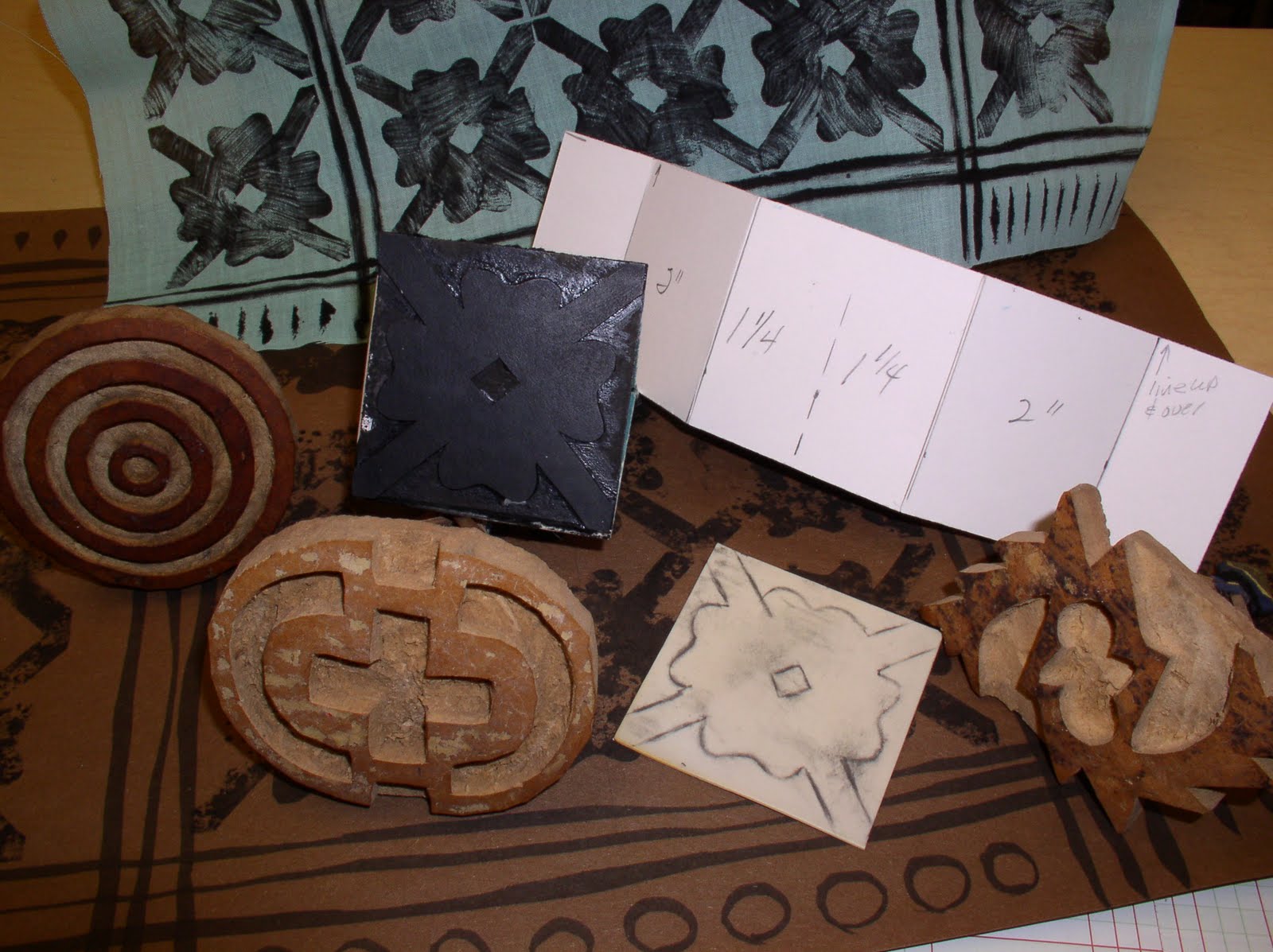
After researching the history of Adinkra and how Adinkra stamps are carved from gourds, the Art 2 students each designed their own personal symbol and created a stamp with adhesive backed easy-cut and mat board.


The students tested printing a variety of colors and patterns with their personal symbols.

When the students were not working on their Adinkra stamps, or making handmade paper, they were each designing a book focusing on their personal interests, beliefs, etc.


Each book was folded and cut from a single sheet of white paper. The students glued their stamped handmade paper to the front and back covers.


Besides the homework research assignment on the history of Adinkra, students were assessed on: their Adinkra symbol design and craftsmanship of printing; the continuity of their idea or theme, craftsmanship and effort for their handmade book; the number of handmade paper pieces (at least 5); and their responsibility in the art studio classroom.