Monday, June 14, 2010

Exploring Indigo & Walnut Dye with Potato Dextrin Resist on Handmade Paper

 I love indigo and walnut dye!  The walnut dye was made from walnuts collected at the home of textile artist, Pat Vivod's, garden a few moons ago when I was working on my research, "Handmade Paper from the Crops of Madison County" at SIUE in 2004-2005. Stored in plastic containers in the basement pantry, the dye has stayed as fresh as the day it was boiled and strained.

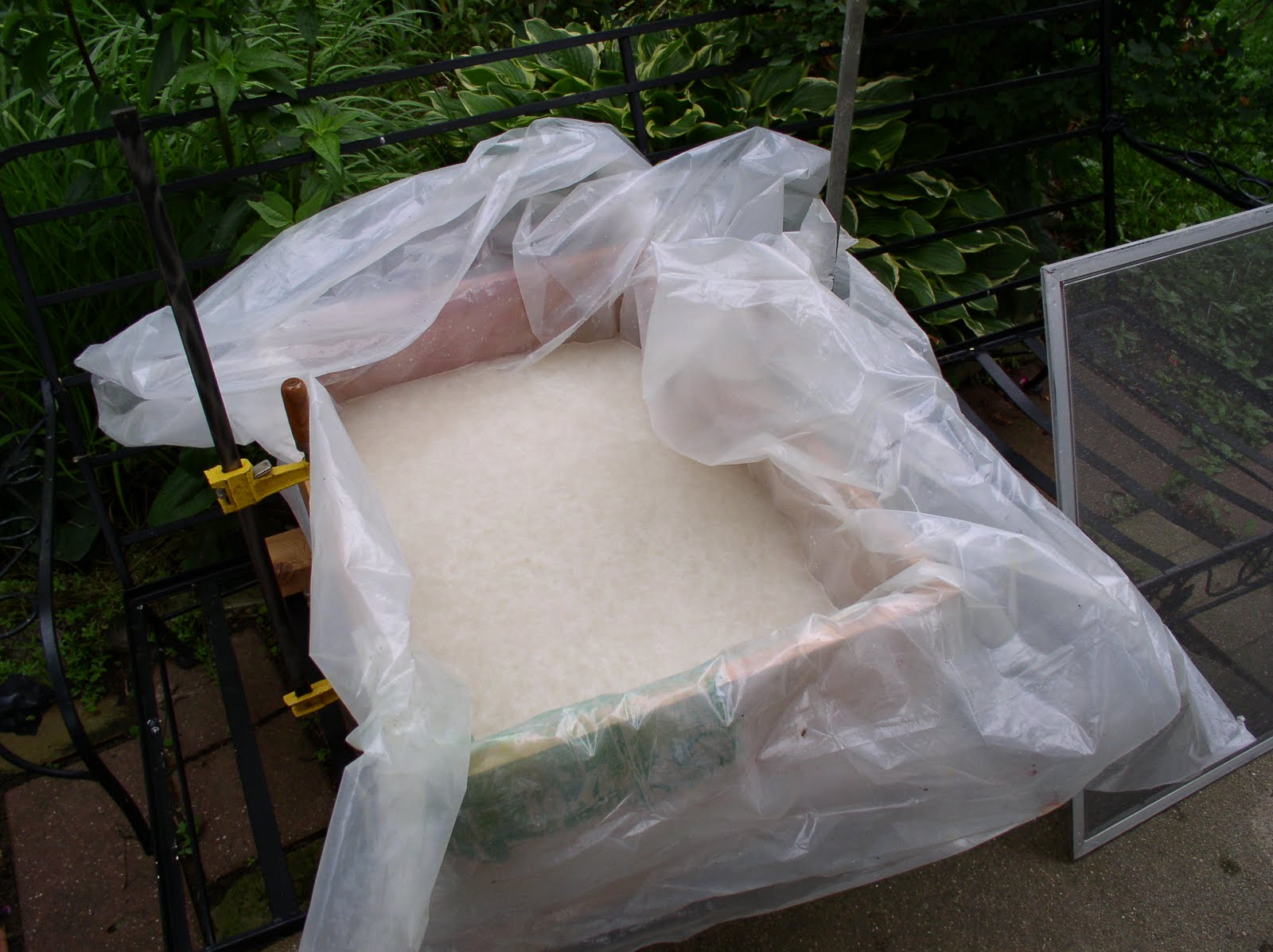
Since my indigo vat is set up in my art classroom down in Oakville, MO, I am using the vat at SIUE to dye my paper. The photo (above) was taken during my research of one of the crop fibers alone without sizing.  Since the paper was not strong enough by itself, a screen was used to support the paper during the dyeing process. The abaca and kozo paper that I am currently using is so strong that I can dye, crush, paint with potato dextrin, dye again and wash it multiple times.

Indigo & Walnut Dyed and Embossed Handmade Abaca and Kozo Paper with Ketene Dimmer Sizing Added to Vat When Pulling Sheets of Paper

More Handmade Paper Possibilities with Kozo Amate Layers

Vintage Family Photos Printed on Pellon Soaked in Bubble Jet Set, Dried and Pigmented Before Printing; Flax Pants Paper Beater Test Samples on Left

Walnut Dye and Gelatin Sizing Over Drawings with Potato Dextrin on Vat Sized Abaca & Kozo Paper

Walnut Dye and Gelatin Sizing over Indigo Dyed Paper (top left); Indigo and Gelatin Sizing (bottom left); Walnut Dye and Gelatin Sizing over Dried Potato Dextrin Drawings - All Abaca & Kozo Handmade Paper with Ketene Dimer Sizing Added to Vat


Thursday, June 10, 2010

Mourning Has Broken

As I was cleaning and organizing the wet studio on Wednesday for the next three weeks of papermaking, I rediscovered many of the textiles and handmade paper artworks I created and exhibited, then stored while working on my BFA and BS in Art Ed a few years ago.  Although my busy schedule teaching and finishing my MSEd has only allowed me a minimum of time to create new art, I did have snippets of time in the studio creating work for two shows at Main Street Art Gallery in Edwardsville.  Yet, I didn't have it in me to clear off the shelves or dig through the piles of scraps saved just in case they could be used in the future.  What I didn't realize until this week was that each object I had stored still held memory, and with that memory, a power to keep me from moving on.  Most of my artwork during the past decade has focused on people who I have lost, found or abandoned during my life.  One of the pieces created for my BFA show had the same title. 

Lost, Found and Abandoned (2006)

Yet this week was different.  As I unwrapped each piece, I felt the loss of each person's death along with the joy of having loved that person in life.  Package after package, person after person, I allowed myself to grieve and to cry for their absence.  And when it was done, I was free.  The fifteen-year-long process of healing was complete.


For the rest of the day, the muck of the wet studio could not suppress my boundless joy! As I worked, I kept hearing Cat Stevens' song, Morning Has Broken.  What a gift from our Lord!!  Cleaning was pure pleasure. 


Pumped with turtle power (one little step at a time, just like my recovery), the studio was cleaned from the floor drain to the top shelves while the Hollander beater hummed along filled with flax.  In July, Betsy and I will clean the two second floor rooms and turn my little dry studio into her guest room, while moving the studio supplies into her larger old bedroom.  I can hardly wait to open the rest of the boxes and get on with living life!!

Making Paper in a Pour Vat in the Garden


Early this morning, with cup of coffee in hand, I set up a papermaking station in the garden.  I made the pour vat a few years ago out of wood, pipe clamps and Carraige House Heat Shrinking Polypropylene Screening while creating a series of larger handmade paper pieces. 


This pour vat was lined with plastic and filled with overbeated flax fibers beaten in my Critter hollander beater..
 

Once the fibers were evenly dispersed in the water, I held my breath and prepared to pull.


With much concentration, and a bit of brute strength, the plastic was quickly removed.


Quickly, the vat was gently shaken as the water drained and the fibers settled on the pellon felt.


The pulp was allowed to drain for a few minutes before the deckle was removed.


The color variation in the pulp was created by pouring a second batch of older overbeated flax over the pulp before it drained. The older flax had been stored in my fridge since 2005.


The wet pulp and felt were carefully pulled off the mould and onto an old window screen before a piece of burlap Columbian coffee bag was placed over the pulp for texture. The metal grid was placed over the burlap.


The whole stack was flipped over and the window screen was removed.


Finally, wooden boards and concrete pavers were placed over the stack to restrain dry for the rest of the day.


I pulled three pieces of paper this morning, two overbeaten flax and one overbeaten abaca.  Hopefully they will be dry by tomorrow and ready for the next step - geletin sizing, piecing, sewing, indigo, walnut dye, etc.

Wednesday, June 9, 2010

Pulped Pants


I first wore these linen pants to my daughter, Betsy's, undergrad graduation from Florida Gulf Coast University a few years ago.  Now that I am 14 pounds lighter, the pants were either going to Goodwill or the studio. 


After cutting up the linen with a roto cutter and putting it in the critter (hollander beater), 1/2 pound of abaca was added to get things moving.  Test sheets have been made at 2 and 3 hours.  At 3 hours, the pulp still wants to clump up after moving freely for no more than 10 minutes.  The bottom layer of pulp moves, but there is a top layer that wants to stop and just float.  Looking forward to tomorrow's tests. 

Saturday, June 5, 2010

Flax in the Critter


Put a load of Type R flax from Carriage House in my critter (hollander beater) at 1:15pm to beat until 7:15.  A critter, handbuilt by Mark Lander in Loburn, New Zealand, is a hollander beater used for processing fiber into pulp for papermaking. Half of the flax was beaten in a vintage Lee McDonald beater at SIUE on Friday. We will compare notes on the flax on Monday.  It feels so good to have the opportunity to have my hands back in a vat of pulp again.  For me, the process of papermaking has always been a cathartic experience that cleanses and pacifies my soul.

Thursday, May 27, 2010

Recent News Article About My 6th Grade Art Class

Oakville Middle School Art Students Benefit from Designated "Play" Time

The sixth grade art students at Oakville Middle School recently had the opportunity for designated “play” time when they participated in the “Hands, Heart and Mind” Environmental Education workshop provided by Susan Blandford, executive director of the St. Louis Teachers’ Recycle Center, Inc., on Thursday, May 6. The workshop, which provided students with creative, hands-on curriculum, was funded through a grant from the local chapter of the Painters and Allied Trades for Children’s Hope (PATCH) Foundation.

During the workshop, Blandford instructed students to select a type of recycled material and play with it for 15 minutes. Following their play session, students then wrote about what they did with their materials and why; Blandford also gave students the opportunity to explain their artwork to their classmates.

“It’s the process, not the product, that matters,” said Blandford. “It’s about the way you think. There is no right answer.”

The St. Louis Teachers’ Recycle Center, Inc. gathers creative materials from local businesses and industries that otherwise would have been thrown away and makes them available to teachers, parents and youth groups. The organization’s traveling reuse center, “Van GO,” allows Blandford to collect and distribute materials used to motivate creative learning and thinking among students.

The OMS sixth graders who participated in Blandford’s workshop are students in art teacher Elizabeth Adams-Marks’ exploratory class. During this section of the course, Adams-Marks teaches students about careers in the field of art, and the sixth graders are responsible for using recycled materials to design and create a structure relating to an art career.

“This workshop ties directly into the interdisciplinary curriculum of our career wheel,” Adams-Marks said.

The “Hands, Heart and Mind” Environmental Education workshop was funded for the OMS students by the local chapter of the PATCH Foundation, which was founded by members of the International Union of Painters and Allied Trades to support children’s charities.

“This seemed like a win-win program; the kids benefit from the workshop and the materials are kept out of the landfill,” said Gary Otten, member of the local PATCH Foundation chapter who suggested giving a grant to the Teachers’ Recycle Center. “I thought it was a good idea, and I’m glad it worked out.”

http://www.mehlvilleschooldistrict.com/wc/Default.asp?info=856968784_1-PressRelease-370&Previous=

http://stlouisteachersrecycle.homestead.com/

Saturday, May 22, 2010

Papermaking with Children

If you are interested in making paper with your children over the summer, follow the link to one of my lessons on papermaking with kids at Incredibleart.org. You will need very few supplies, most of which you probably already own. http://www.princetonol.com/groups/iad/lessons/middle/elizabeth-paper.htm